Faces of the Atlas
Alexander the Great
He ran out of world before he ran out of ambition
- Born
- 356 BC
- Died
- 323 BC
- Origin
- Pella, Macedon (modern Greece)
Conquering the Persian Empire and marching an army to the edge of the known world, undefeated in battle
Early Life
Alexander was born in 356 BC at Pella, capital of Macedon, son of King Philip II and Olympias, a princess of Epirus. The year is secure; the traditional July birthday is convention rather than certainty. One caveat colours everything on this page: no account written in his lifetime survives. The five main ancient histories were written three to four and a half centuries after his death, working from lost eyewitness memoirs — so even the best-attested facts below reach us second-hand.
The education, at least, is genuinely true and not legend: from about age thirteen, Alexander was tutored by Aristotle. What the philosopher actually taught him is mostly guesswork, but the results came fast. At sixteen Alexander governed Macedon as regent while his father campaigned; at eighteen he commanded the decisive cavalry charge at Chaeronea, the battle that broke Greek resistance to Macedon.
Around the boy, legends grew like ivy — and they should be labelled as such. The most famous is Bucephalus, the untameable horse: Plutarch, writing four hundred years later, tells how young Alexander noticed the stallion feared its own shadow, turned it toward the sun, and rode it, while Philip wept that Macedonia would be too small for his son. Charming, unverifiable — though built on a true core, because the horse was real, carried him all the way to India, and had a city named in his memory. The birth omens — Olympias dreaming of a thunderbolt, whispers that Zeus was his true father — are the same kind of story, told as tales even by the ancients who recorded them.
In 336 BC Philip was assassinated by one of his own bodyguards, and Alexander was acclaimed king at about twenty. Whether Olympias or Alexander himself had any hand in the murder was rumoured then and is speculated about now; it can never be proven either way.
The Fall of Persia
In 334 BC Alexander crossed into Asia and never came back. At the river Granicus he fought his first battle against Persian forces and was nearly killed in the cavalry melee — saved by Cleitus the Black. Asia Minor opened. The next year at Issus he faced King Darius III in person on a narrow coastal plain; Darius fled the field, abandoning even his own family. To the march through Anatolia before Issus belongs the Gordian Knot, with its honest asterisk: the visit is attested, but "he sliced it with his sword" is only one ancient version — another says he simply pulled out the pin holding the knot together.
What could not be won by battle he won by siege and by welcome. Tyre, an island city, resisted for seven months until Alexander built a causeway across the sea to reach it — an engineering feat still studied today. Egypt greeted him as a liberator; there he founded Alexandria, greatest of his roughly twenty city foundations, and travelled deep into the desert to the oracle of Zeus-Ammon at Siwa. What the oracle told him was never recorded — "the god called him his son" is how the tradition later spun it, and the ram's horns on his coin portraits grew from that story.
The decisive day came on 1 October 331 BC at Gaugamela, on flat ground Darius himself had chosen — a date fixed by astronomy, since a lunar eclipse eleven days before appears in both the Greek sources and Babylonian records. Alexander's oblique attack tore a gap in the Persian line, Darius fled again, and the Persian Empire effectively fell. In 330 BC the palace complex at Persepolis burned. That it burned is certain — archaeology confirms the layer of ash. Whether it was calculated policy or a drunken party that got out of hand, egged on by the Athenian Thaïs, is a debate the ancient sources started and modern historians have never settled.
The Journey East
Darius was murdered in 330 BC by his own satrap Bessus, who fled to Bactria and declared himself king. Chasing him pulled Alexander into the wildest country he ever fought in. He wintered in the Kabul valley and founded a city there — Alexandria in the Caucasus, near modern Begram — because the Greeks called the great range ahead the "Caucasus." We call it the Hindu Kush.
In spring 329 BC he took the army over it, deliberately choosing a harder, higher route because Bessus had stripped the easy one bare. The crossing took roughly fifteen to seventeen days through deep snow, at altitudes that sickened men, with so little food and fuel that the sources say troops ate their pack animals raw for lack of firewood. Which pass he used, no ancient writer names; most scholars think it was the Khawak Pass at the head of the Panjshir valley, but the honest answer is that the sources only tell us it was high, snowbound and hungry. He would cross the range again, southbound, in 327 — but the 329 crossing is the famous starving one.
The gamble worked. Bessus's support collapsed and his own officers handed him over. What followed was harder than any battle: two brutal years of guerrilla war in Sogdiana, the toughest fighting of Alexander's life, capped by the capture of the mountain fortress called the Sogdian Rock — and his marriage to Roxana, a local noblewoman.
Then India. At the river Hydaspes in 326 BC he defeated King Porus and his war elephants in a monsoon river crossing — his last great set-piece battle. Bucephalus died around this time, and Alexander founded the city of Bucephala on the river in his horse's memory.
The Long Road Back
At the Hyphasis river in the Punjab, in autumn 326 BC, Alexander's conquests met the only force that ever stopped them: his own army. The men refused to march further east toward the Ganges. The veteran officer Coenus spoke for them; Alexander sulked in his tent for days, then yielded and turned back. Some modern historians suspect later writers dressed the "mutiny" up for drama — but the turn-around itself is certain.
The way home was worse than any enemy. In autumn 325 BC he marched part of the army through the Gedrosian desert — the coastal Makran, in modern Iran and Pakistan — while his fleet sailed alongside. Heat, thirst and flash floods that drowned the camp followers did what no battle had: Arrian says Alexander lost more people here than in all his battles combined. That is a proportion, not a count — the real numbers are unknowable — and why he chose the route at all, whether to supply the fleet, from geographic ignorance, or to outdo legendary conquerors before him, is genuinely debated.
The last two years make uncomfortable reading, and the sources let you read them two ways. Well-attested: he executed corrupt governors en masse on his return; staged the mass weddings at Susa, marrying his officers to Persian brides in a bid to fuse the empires; faced down a second near-mutiny at Opis; and was wrecked by the death of Hephaestion, his closest friend, mourning with an extravagance the sources found alarming. Heavy drinking runs through every account of these years — as it had in 328, when he killed Cleitus, the man who once saved his life, in a drunken quarrel. Whether all this adds up to a king becoming a paranoid tyrant is a modern reading — a serious one — but Arrian's Alexander remains more sympathetic. The honest page lets both stand.
Death in Babylon
In June 323 BC, after a banquet in Babylon, Alexander developed a fever. Over some ten to twelve days it worsened; he progressively lost the ability to move, then to speak. The day-by-day account survives because both Arrian and Plutarch quote the court's official diaries — unusually good sourcing — and a Babylonian astronomical tablet in the British Museum records the king's death on a date equal to 11 June 323 BC, making it one of the best-fixed dates in all of ancient history. He was thirty-two, and he had never lost a battle.
What killed him is a debate two thousand years old. The strong scholarly majority says natural causes: typhoid fever, malaria, and Guillain–Barré syndrome are the leading modern diagnoses, with old wounds and exhaustion plausibly lowering his resistance. The rival story — poison, in a plot traced to the regent Antipater and his sons — existed within a generation of his death. But even the ancient writers flagged it: Arrian and Plutarch both report the rumour and both reject it, Plutarch noting it surfaced years later, precisely when it was politically useful.
The deathbed has its own legend, labelled accordingly: asked to whom he left the kingdom, Alexander supposedly whispered "to the strongest." The sources report it as a story, and it is likely a later invention foreshadowing what came next. Even his body kept travelling — hijacked to Egypt by his general Ptolemy, entombed in Alexandria, visited by Julius Caesar and Augustus. The tomb has been lost since antiquity. No one knows where he lies.
Legacy
Alexander left no adult heir, and the answer to "to the strongest" turned out to be forty years of war. His generals — the Successors — carved the empire into the great Hellenistic kingdoms: Ptolemaic Egypt, which lasted down to Cleopatra; Seleucid Asia; Antigonid Macedon. But the conquests outlived the wars. Koine Greek became the common tongue from the Mediterranean to the Hindu Kush — the language the New Testament would later be written in — and Alexandria grew into the intellectual capital of the ancient world, home of the great Library.
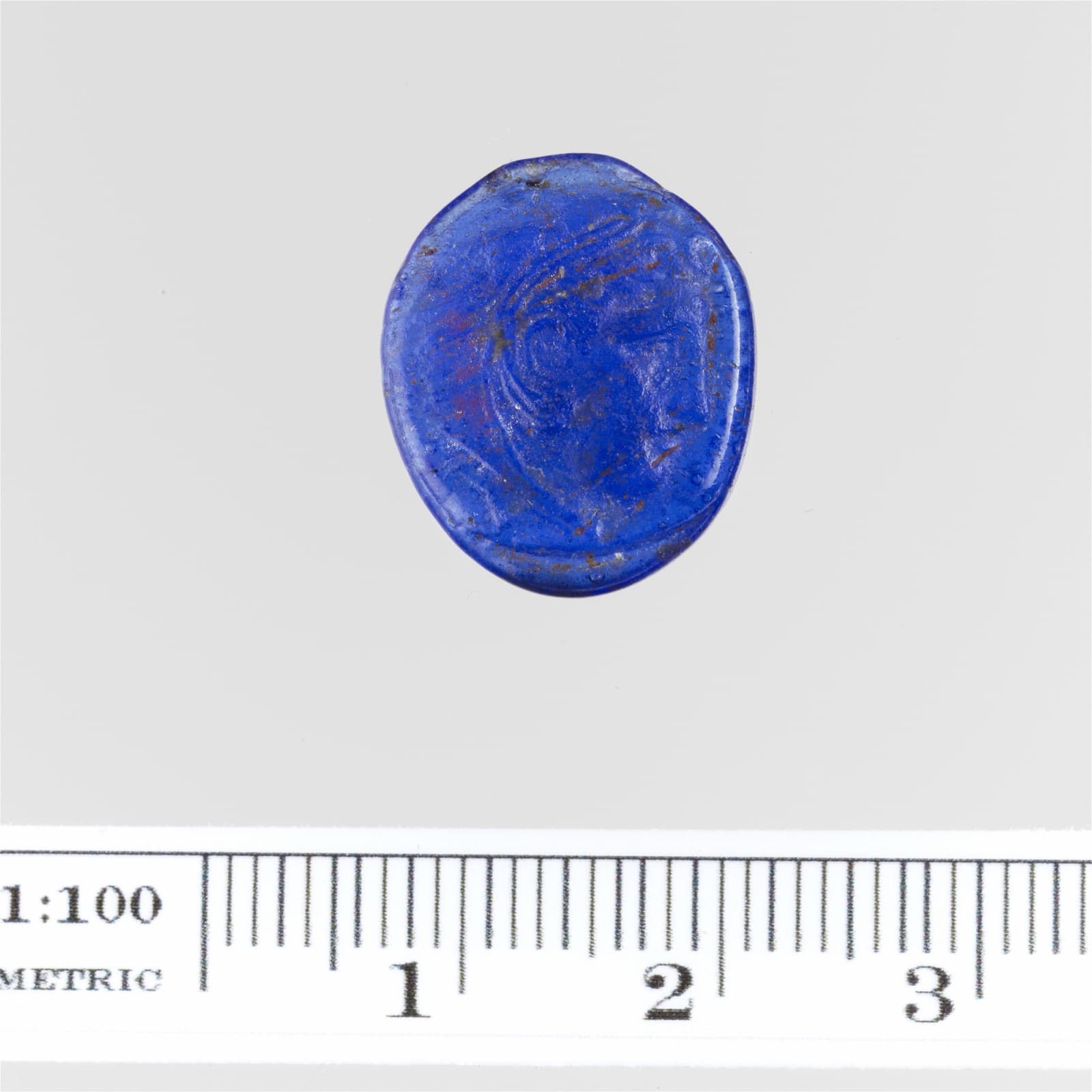
His face became currency, literally. The Successors stamped his portrait on their coins to borrow his legitimacy — Lysimachus's silver tetradrachms, showing Alexander with the ram's horns of Ammon, are effectively the first time a real human being's portrait dominated coinage. Further east, in the lands he had crossed, Greek sculptural style met Buddhism and produced the Greco-Buddhist art of Gandhara — a legacy you can still see in stone.
And then there is the legend. The Alexander Romance, a cycle of tales that grew for a thousand years, carried him from Persia to Ethiopia to medieval Europe — Iskandar in the Persian tradition, folded into Islamic tradition too — making him arguably the most storied human being of antiquity. All of it legend, and gloriously so. Historians still argue over the man underneath: visionary unifier or destructive conqueror whose toll on Persia, Sogdiana and India was enormous. Both readings have serious champions. This page lets you hold both.